
Rise Operating Model Refresh
An Operating Model Refresh to Simplify Collaboration and Improve Delivery Flow
Clarify ownership, clean up overlapping responsibilities, and restore predictable cross-functional execution across two or more business areas — even as automation and AI accelerate delivery cycles.
The Results You’ll See
Clear ownership & accountability
→ Less escalation. Less confusion. Fewer repeated conversations. Fewer unnecessary meetings! Teams know exactly who leads, who supports, how decisions are made, what success looks like.
Cleaner, more efficient & consistent ways of working
→ Faster decisions. Transparency. Happier teams. No more duplicated projects, conflicting priorities, or misconfigured tools. Workflows, handoffs, processes, and tooling become aligned across the overlapping functions.
More predictable planning and execution
→ Fewer last-minute shifts and more confidence in delivery. Requests are standardised, communication flows improve, and teams gain a shared operating rhythm.
Who This Is For
If you’re a CEO, COO, CHRO or Senior Leader responsible for cross-functional performance, here’s how to know whether this programme is the right fit for your organisation.
This is a strong fit if:
Two or more teams stepping on each other’s toes
Unclear decision ownership or repeated escalations
Parallel planning or duplicated work
Tools and workflows configured differently across teams
Not a fit if:
You’re <40 people with intentionally fluid roles
You want a full-scale enterprise transformation programme
If you’re not the budget holder:
You can frame this as:
Reducing friction and operational noise
Improving planning reliability without increasing headcount
Creating clearer ownership across teams
Use Case: Commercial vs Marketing Overlap
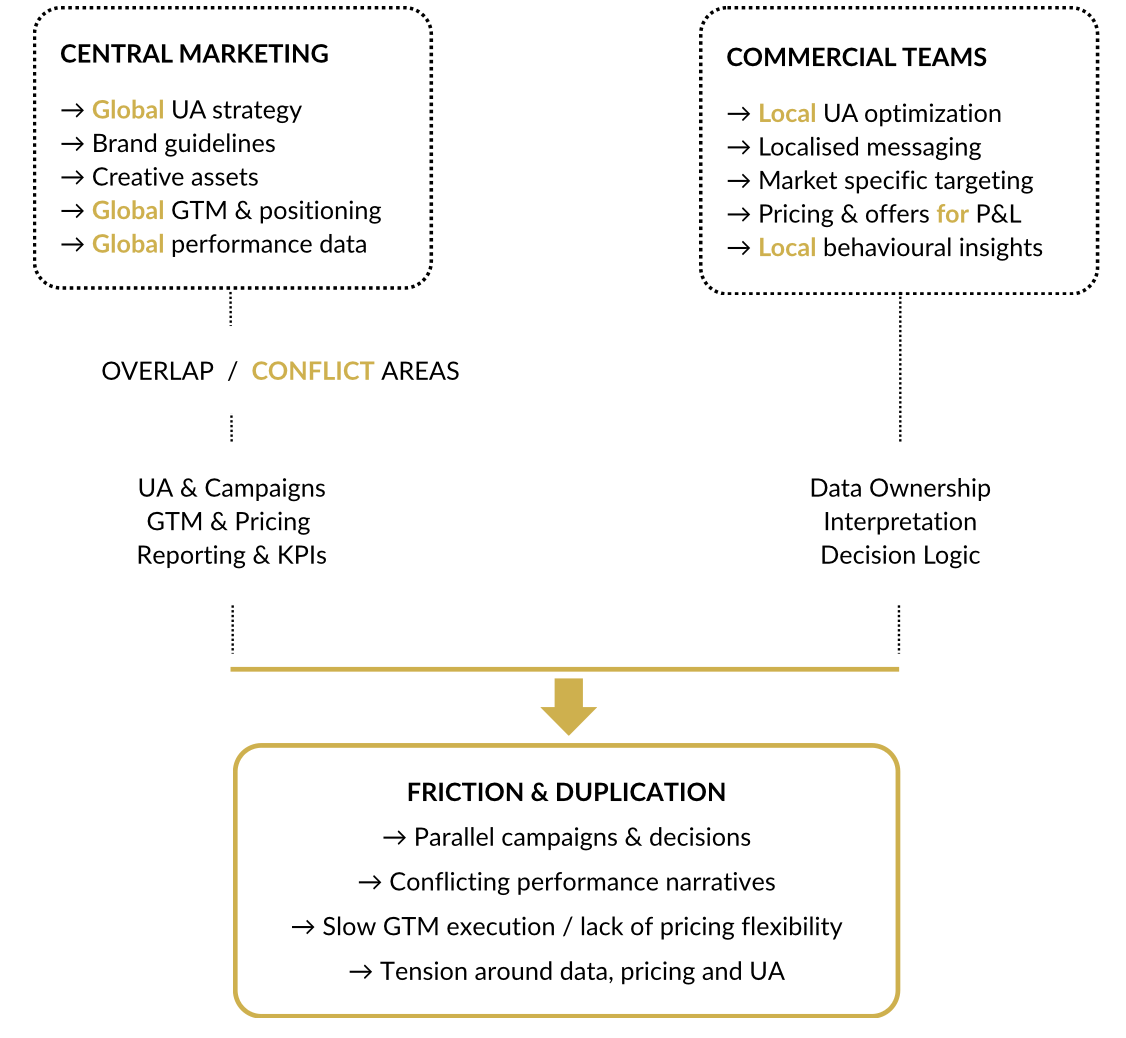
When a centralised marketing function overlaps with regional commercial teams (P&L ownership), friction often emerges around:
user acquisition vs brand governance,
data ownership and interpretation,
GTM and pricing decisions.
These overlaps create:
duplicated work,
conflicting priorities,
inconsistent execution.
AI and automation-enabled tools can increase workload velocity, but without clarified ownership and aligned workflows, they amplify existing friction rather than reducing it.
Using the Rise Operating Model Refresh, the organisation aligns ownership, creates a clear global-to-local decision model, unified data definitions, and streamlines UA and GTM workflows so both manual and AI-driven execution flows predictably.
Use Case: Cross-Operational
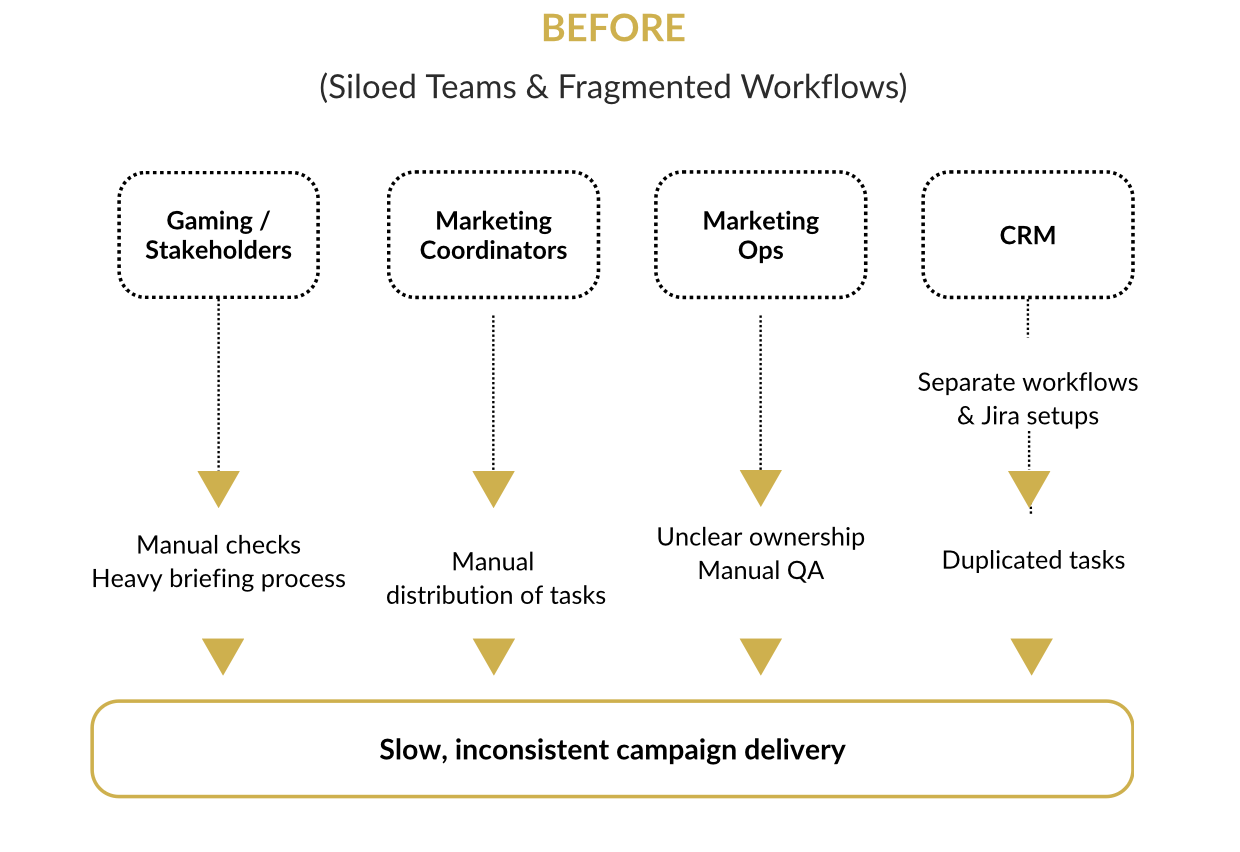
Several stakeholders and operational teams (marketing ops, CRM, QA, coordinators, creative) were working in silos with separate workflows and Jira setups, leading to duplicated work, manual checks, unclear ownership, and slow, inconsistent delivery.
Using the Rise approach, we mapped the end-to-end flow, uncovered redundancies and overlapping responsibilities, and identified major automation opportunities, including where AI-enabled tools could accelerate parts of the workflow once ownership and pathways were clarified.
Impact:
40% faster campaign delivery
80% of coordinator workload automated
Manual checks removed
Automated briefing process
Unified workflows, shared tooling
Outcome:
Faster time-to-market, clearer ownership, lighter workloads, significantly reduced cross-team friction and a foundation for AI/automation that improves execution reliably rather than amplifying noise.
Use Case: AI-Accelerated Workflows
As automation and AI speed up execution, unclear ownership and handoffs between teams show up faster and create more expensive bottlenecks.
Examples:
Automated workflows trigger work, but two teams assume responsibility for the same task
AI-driven priorities conflict because ownership and escalation paths aren’t defined
Auto-routing increases volume, but approvals and handoffs lack clear accountability
AI-enabled scheduling pushes tasks into queues faster than teams can coordinate approvals or resource allocation.
Rise clarifies ownership, interfaces, and decision pathways so automation and AI scale without escalating overlap, delays, or rework.
How Rise Works
Phase 1 — Understand
Interviews, workflow mapping, decision path review, tooling assessment.
Output: factual view of friction points.
Phase 2 — Simplify
Clarified responsibilities, redesigned collaboration points, refined planning flows, tool alignment.
Output: a cleaner, more predictable way of working.
Phase 3 — Implement
Introduce the new model, support adoption, refine based on real usage.
Output: the model works in practice — not just on paper.
What You Get
You’ll receive practical artefacts your teams can use immediately:
Decision & ownership map
Cross-functional workflow & handoff map
Standardised request/briefing templates
Shared planning & prioritisation cadence
Tooling recommendations
Implementation support during early adoption
Why Work With Me
Objective and independent
I bring no internal biases, assumptions, or history. This allows me to surface issues teams often can’t see — or don’t feel comfortable raising.
Cross-functional expertise
My background spans operational design, planning, tooling, CRM/automation, BI alignment, project management and strategy-to-execution workflows. I understand how functions depend on one another and where friction tends to form.
Deep operational insight
I don’t rely on generic frameworks. I understand how decisions, processes, tooling, and data flows actually work inside growing organisations — and how to make them simpler and more effective.
Practical, lightweight implementation
No heavy transformation programme. No disruption. Just clear, actionable changes that teams can adopt quickly and sustain long-term.
Built to scale
We begin with the areas where friction is most visible, and once validated, the operating model can expand across the wider organisation without re-starting from scratch.
Next Steps
Initial conversation — goals, context, fit
Proposal review — scope, outcomes, timeline
Approval — short engagement agreement
Kickoff (30–45 mins)
Start of Phase 1 — diagnostic begins
Explore Whether Rise Is a Fit
A short introductory call is the simplest way to assess your context, the friction you’re seeing across teams, and whether Rise is the right mechanism to improve cross-functional execution.